Showing posts with label Curriculum. Show all posts

Wednesday, 12 September 2018

Learn the Classical Art of Persuasive Speech {Review}

Wow!  Sometimes timing is everything!


{Affiliate links may follow.}

Shortly after my family and I joined a local Christian speech and debate club, I was offered a chance to review Fitting Words Classical Rhetoric (complete program) by Roman Roads Media.


At that time, I had not previously heard of Roman Roads Media, which also offers two subscription programs that other Crew Review families have been usingPicta Dicta Natural World or Picta Dicta Vocabulary Builder.  However, immediately upon perusing the Fitting Words Classical Rhetoric page on their website, I knew Roman Roads Media was a company I wanted more familiarity with.  Their curriculum on persuasive speech from a Christian lens was just what I needed to enhance my own learning.

Yes, I did just say "I".  


Although Fitting Words Classical Rhetoric is meant for high school students, I wanted to review it for my own edification and so that I could better assist with our local speech and debate club.  For, although I have a strong background in drama and education - and even made a living as a public speaker at one point  - I have little background in logic and debate and felt Fitting Words Classical Rhetoric would help me step up my game.


That it doing!  So far, I'm only partially into 
Fitting Words Classical Rhetoric's 30 lessons and already thoroughly impressed with what an informative, robust, yet digestible rhetoric curriculum it is!  Moreover, I love that it takes an unashamedly Christian worldview.

The complete curriculum surely s helping me hone my understanding  of how to be informative in truth, powerful through moving others towards goodness and virtue, and elegant by using delightful verbal beauty.  Surely, this understanding will help me help the students in our local speech and debate club, too.

They Aren't Kidding When They Say "Complete Program"


Fitting Words Classical Rhetoric (complete program) is just that - complete!


The program came to me  packaged with its very own sturdy tote bag - a touch that I appreciated and one that made me think how Roman Roads Media takes its teaching to heart - ensuring even its products - which teach truth and beauty - are packaged beautifully and can stay organized and neat at home or on the go.

It consisted of:


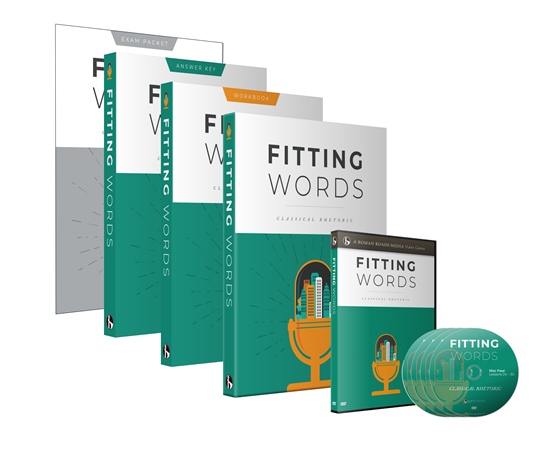
  •  a thick hardcover textbook:  This meaty text is close to 400 pages with 30 lessons, spread over 7 units with introductory materials, an appendix of speech texts, an appendix of speeches within the Bible, a Glossary-Index, and Works Cited included.  That may seem almost too hefty, but trust me, it the layout is user-friendly and the content excellent!


Wide margins with images, Key Concepts, Famous Orator highlights, etc. make the text visually appealing.  Sections in each chapter for "Thinking deeper", "Developing Memory", "Reading Further", and "Notes" encourage depth.  And, well-written, clear, and relatively concise text explains everything you need to understand Rhetoric.


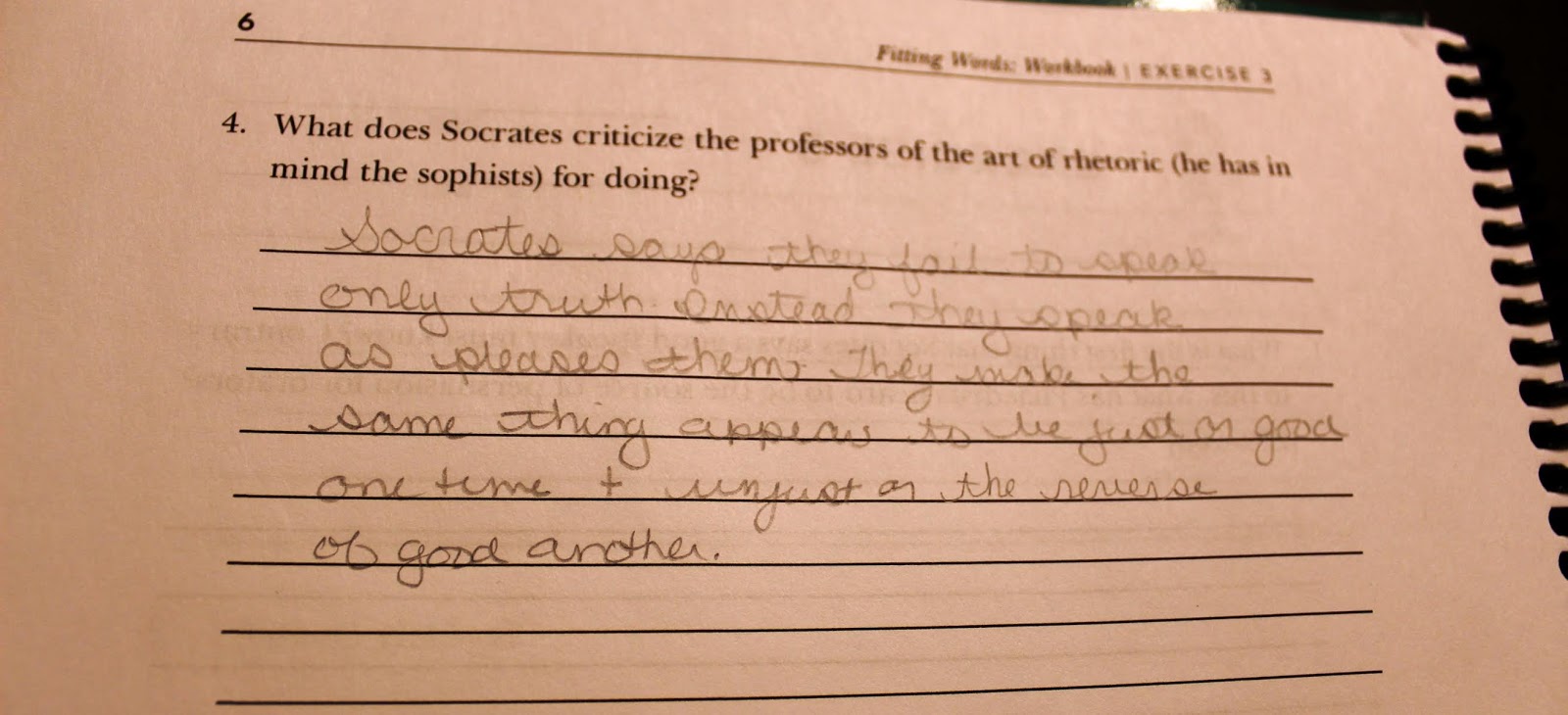
  • a spiral bound, soft-cover workbook: Details.  Details.  Details.  Not only does the workbook help you hone into details with clear though and no fill-in-the-blank filler, but the design of the workbook includes two favorite details I appreciate in such materials: spiral-binding and plenty of white space!  As you write out answers to each exercise, you do not have to fuss with trying to keep the workbook open since it is spiral bounce and lays flat beautifully.  You also have plenty of lined spaces for writing answers and wide margins for any notes you might want to add. The workbook also includes speech judging sheets.

  • a regular bound softcover answer key: This contains optional one-and two-year course schedules, answers to all the exercises in the student workbook, and answers to the exams. It also stands above many other answer keys I have seen, because it provides ideal answers for every question from the workbook.  There are no "answers will vary" - just good, solid, complete-sentence answer examples!
  • a shrink-wrapped exam-pack:  This handy stack of nine pre-preprinted loose 3-hole punched exams would come in handy for anyone taking thi course for credit that does not want to deal with printing and punching papers
  • a 4-disc video course: Clear, crisp video with eloquent presenters make this 18-hour video course an appealing component that compliments the text and workbook.  There are tow videos for each lesson from the text - one "lesson" and one "application video", like this:


There are also nine pre-exam videos to ad with studying.  It is recommended that student watch the video lessons before reading text lessons.  I found it worked well for me either way around.  I could read the text while out and about and view videos when I had quiet time, with one reinforcing the other no matter which order I was able to use them in.

    Fitting Words Classical Rhetoric

    It is also recommended that you keep a commonplace book of quotes.


     Roman Roads Media
    Roman Roads Media


    Traditional in its approach, thoughtful in its design, and wholly pointing to what is true and beautiful, Fitting Words Classical Rhetoric truly is a complete program!

    Would I Recommend It?  You Bet!

    Roman Roads Media


    My elementary and middle-school aged children are not yet ready to to glean all the benefits of this Rhetoric program, but as I make my way through the classical art it teaches, I cannot wait until they are old enough to learn directly from the program.  Until then, I a happy to be learning myself, so I can sprinkle bits of knowledge here and practical tips there.  I have no doubt that going through the program materials myself will help me be a better speech and debate mom!  I also have already found myself recommending the program to local parents of high school students.

    By the time you finish the program, you will have prepared and delivered 5 speeches:

    1. one designed to produce a particular emotion in listeners
    2. a forensic speech of accusation or defense
    3. a political speech urging hearers to do or not to do a course of action
    4. a speech of praise
    5. a free choice final topic

    You will also develop a comprehensive and practical understanding of rhetoric, having studied examples from some of the greatest speeches in history and Scripture and focused on theory, imitation, and practice of persuasive speech.  Further, you will do all this from the a Christian worldview, grounding yourself in truth and beauty as you practice a timeless art that you can use to affect change.

    Roman Roads Media


    Without question, I consider Fitting Words Classical RhetoricI  I would also be interested in checking out more of the Classical curricula they offer as highlighted here:


    Read more reviews!

    Find Roman Roads Media on social media:


    Crew Disclaimer

    Thursday, 2 August 2018

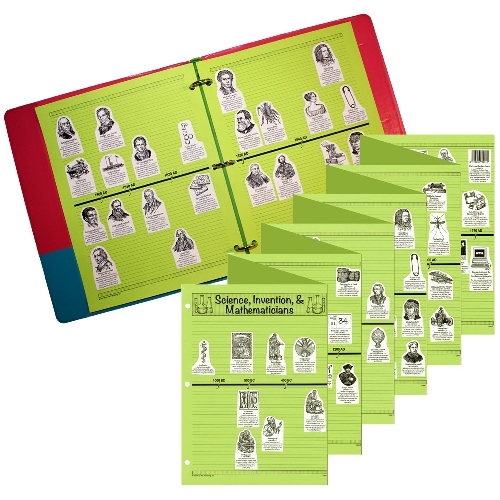
    Get Hands-On with Ancient Greece ! {A Home School in the Woods Review}

    If you like history and hands-on learning, you will love Project Passport World History Studies by Home School in the Woods!


    We have been enjoying the Ancient Greece study recently and, like everything we've tried before from Home School in the Woods, we have found the quality of the Greece study to be top-notch.

    What is Project Passport: Greece?


    The Project Passport World History Study Ancient Greece is a resource that makes learning Greece hands-on and memorable.  The study has depth, breadth, flexibility, and fun!
    You can use the complete curriculum as a deep, hands-on study of Ancient Greece, or you can pick and choose projects based on specific topics that catch your interest.  You can also do as many or as few projects as your life and learning schedule allow, since projects can stand alone or can complement one another.  That means that the Ancient Greece study can work equally well as a stand-alone curriculum our as a stellar supplementary one.

    However you choose to use the Ancient Greece study, you are sure to find yourself immersed in active learning and review alongside your children!


    Text portions are well researched and written, directions are explicit and easy-to-follow, and projects are engaging and often punctuated by delightful hand-drawn illustrations.


    Make Up to 25 Stops on Your Virtual Journey Through Ancient Greece


    Project Passport World History Studies Ancient Greece is recommended for students in Grades 3-8 and is available in a CD format or as a digital download, which is what my family received

    The download version comes "zipped".  Once unzipped, the download has multiple folders and files accessible in your document folders or through 
    a handy "start" button, which automatically opens a hyperlinked welcome page that makes navigating the copious amount of included files easy.  By clicking on the "start" button, you can easily get on with your learning journey without having to wonder, Where do I begin and how do all these files work together?


    Included in the curriculum are 25 "stops", or lessons, which will take you 8-12 weeks to complete if done as suggested.  However, as I said before, the curriculum is flexible.  You can use it at any pace that works for your family, dipping in here and there, doing the entire thing in order, choosing portions that speak to your children's learning styles...


    My family tends to use things in spurts, picking and choosing activities based on our interests and time availability.  As we've been journeying through Ancient Greece with Home School in the Woods, we have typically checked out some of the included photos of completed projects, read through the menu of specific topics, and, then, let the children work on a select maps, timeline portions, or mini-projects, while I have read the Guidebook (or text) to them, just starting at the beginning and stopping when time for our studies ends on a given day, then picking up where we left off on another day.


    As I have read and the children have worked, we have paused to chat about different points that come up.  This has been working well for us, and I find, therefore, that this curriculum is one I like to do with my children, not one that I would hand over them and say, "Here, go to it!"


    I like being present and reading the Guidebook to the children, so I can learn and discuss as they do.

    Undoubtedly, there is plenty to learn!  Lessons cover a bit of everything - both in specific topics about Ancient Greece (from clothing to government, to mythology, to geography, to people, to so much more) and in ways materials are presented (as maps, lapbook pieces, timelines, printable mini-projects, cooking projects, building projects, etc.)   There are even audio tour portions!  Love that!

    Plans are laid out with clear instructions for what you'll need to print, what extra materials -such as scissors, colored pencils, tape, glue, file folders, cooking supplies, etc. - that you will need to gather, and how you might wish to approach each lesson segment.

    There are also visual snapshots of completed lessons projects, so you can get an idea of what each might look like, or, as I said my children and I do, my children use the pictures, to help you decide which portions of the study to do next.

    Being able to quickly get a handle of what projects are about and might entail through looking at the photos as well as through browsing the well-named links on the "start" page, handy icons on that page, and linked quick-look instructions is a huge perk of the curriculum.  For truth be told, there are so many projects included in the study, that I know my family will never get to them all.

    My time and patience for printing materials is limited and my family's schedule always leans towards "full", so, while we love 
    Project Passport World History Studies, we simply can not commit to "doing it all".  The well-organized nature of the studies and the awesome sneak peak pictures of completed projects, then, help us to decide what we can and will do.  Decisions made, we dive in, and without exception, always enjoy our time journeying through history with Home School in the WoodsWe believe you will, too.

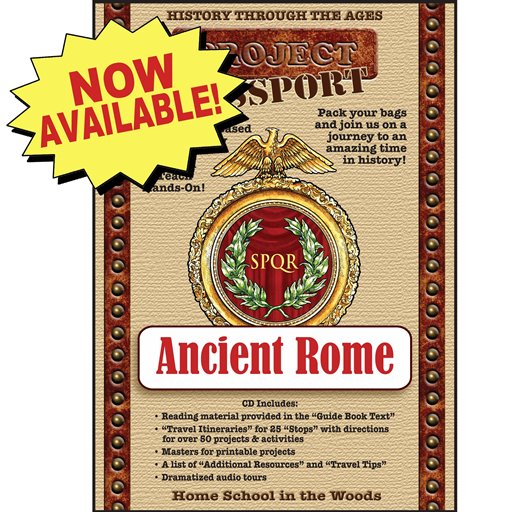
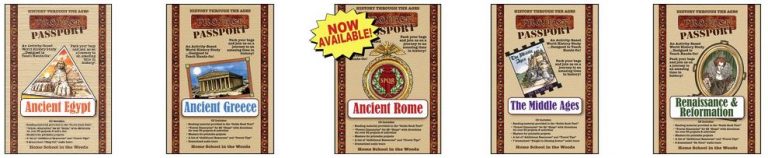
    Seriously, the Ancient Greece study is fantastic!  Taken in part or as a whole it promotes engaged, hand-on learning.  There are other Project Passport World History Studies, too, including a just-released Rome one we hope to do in the future.


    What We Think about Project Passport: Ancient Greece


    By now, it is no secret that the only part of the Ancient Greece study I do not relish is all the separate files for printing.  (I would much prefer files bundled into single documents per type of study - lapbook, mapping, craft instructions, or, better yet, per stop, so I could simply open one document, select pages to print, hit print once, walk away, then, come back to enjoy learning alongside my children.)

    Still, the time and relative tedium it takes to do all the printing is well worth it.

    Why?

    Because each of my children enjoys Project Passport studies and, once we are all sitting together immersed in them, I thoroughly enjoy the time, too.


    No kidding.  We sat down to do a brief amount with the study this past week and found ourselves late running out the door over an hour later because we got so pleasantly caught up in what we were doing that the time flew by!  You just have to love a resource that engages like that!


    When I asked my children for their thoughts on the study so far, my 11-year-old daughter said:


    I really like this Project Passport World History Study on Ancient Greece.  It has coloring sheets and glue projects you can do while Mom is reading.  That entertains your hands while the reading entertains your mind.

    I also enjoyed making a clay pot and helping my brother with his helmet.  These are two of the many crafts suggested in the study.
     

    I think this study is good, because there are lots of different things.  If one person prefers reading, another prefers copying, another drawing, another pasting... there is all of that in there.  There are many different ways to learn about Greece in this study. I really like it!

    Obviously, she enjoys the hand-on nature of the curriculum and also appreciates how different parts of it can appeal to different learning styles.


    My 8-year-old son said:


    I like the crafting, pasting, and coloring.  Mom has not been doing as much of this with us lately, and I really like it.  I also liked learning about Ancient Greece because it is easy and fun.


    So far, I like making the helmet the best.  We did not have everything we needed, so I looked at the directions and came up with other ideas.  I used a toy workers hat duct tape, foam, and cardstock and plan to cover the cardstock with duct tape and try spray painting it all. 

    I think people who like crafting, coloring, pasting, and history would like this!

    I'd say his comments are spot on and would like to highlight that, while my son always doe well with creativity and problem-solving, the clearly written directions for the helmet and the inspirational photos included in the downloads spurred him to easily figure out how to use the pattern and idea for the helmet with the materials we had on hand.  It brought him such joy to do so!


    My 12-year-old son said:


    I wanted to do this study for the costumes, but have not done that part, because we have been so busy and, when we have sat down to use the study I have not been feeling the best.  So, instead, I have listened to Mom read the history parts, done some mapping, and done the Aesop tales.

    I like the way the history is written.  It has a good style and is interesting.  Now, I know why the period is called the Hellenistic period.  I learned some new things and made connections to other things I have learned. 

    I did not like the fact that there is cutting and pasting for the maps, so we printed the key map instead and just colored and found places. 

    I think this study would be good for people who like history as well as for those who think they hate it.  Sometimes history is taught poorly, but this study great.  It's not just names and dates.  It is stories and activities.

    Between a busy schedule out of the house, trouble sleeping, and a summer bug, my oldest has not been himself each time we have sat down with this study. Yet, he has been drawn into things and has also appreciated how we can adapt to his glue-hating ways. (We use the teacher keys instead of the cut-n-pastes for him.) He also has noted what I note: the Project Passport Study can make history engaging for anyone - even those who think they don't like history. 

    We love history here. We also appreciate opportunities for family learning, curriculum resources we can stop and start with as life demands, and well-designed options that help us create memories as we expand knowledge.

    Project Passport World History Studies Ancient Greece is all this and more. It is a fantastic hands-on resource that can be used as a base curriculum or as a supplement to other studies, with you picking and choosing which included projects to complete.

    Well-researched materials engage the mind. Inviting hand-drawn artwork makes for wonderful coloring, painting, or just looking.  A wide variety of activities appeal to visual, kinesthetic, and auditory senses. Everything included in the study is, without question, top notch.


    Home School in the Woods offers a wide variety of products, some in-depth, some one-shot, all well worth a look.


    Read the reviews.


    Homeschool Review Crew Families have reviewed different  Home School in the Woods, including:


    You can also see some of our prior reviews:

    Art, History, and More A La Carte from Home School in the Woods {A Review}


    Flexible, Fun, Hands-On History for Every Learner { A Project Passport: Renaissance & Reformation Review}


    Connect with Home School in the Woods at:


    Crew Disclaimer

    Thursday, 28 June 2018

    Art History from a Christian Perspective {A Review}


    {This post contains affiliate links to a vendor we have been enjoying:The Master and His Apprentices.}


    Are you looking for a faith-connected homeschool art history curriculum

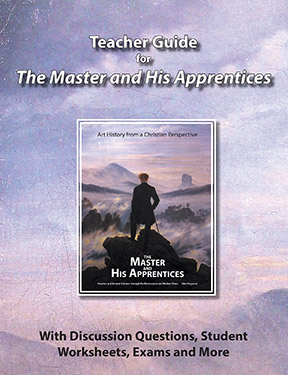
    The Master and His Apprentices: Art History from a Christian Perspective created by The Master and His Apprentices might be just what you are looking for.

    The Master and His Apprentices: Art History from a Christian Perspective would work well for:


    • adults who want to read about art appreciation with a Biblical worldview.
    • parents who to better understand art history in order to teach their children about it, or who are looking for specifically Christian material to supplement other art, history, and faith studies.
    • high school students that desire a full credit art history course that can be used independently, with a co-op, or with a private school.
    • artists who desire to better understand what makes art great.


    The Master and His Apprentices: Art History from a Christian Perspective is particularly wonderful for Christian families because it eliminates some of the problems of secular art history curricula which present materials from a humanistic perspective, failing to view God as the original, ultimate Creator, make no connections between art, artists, and Biblical timelines, and do not present Jesus' life, death, and resurrection as truth, but rather as a myth.  In other words, 
    The Master and His Apprentices: Art History from a Christian Perspective  focuses on what is true and beautiful, leaving out what is questionable!


    What Is Included in This Homeschool Art History Curriculum


    The Master and His Apprentices

    The Master and His Apprentices: Art History from a Christian Perspective is a 380-page textbook course with a teacher guide that was written by a former homeschool student, Gena Ferguson, who has been teaching art, English, history and the Bible for over 12 years. Gena used her experience to create a comprehensive Art History course aimed at Christian highschoolers that provides a full credit of Art History when used with the materials from the teacher guide. 

    Of course, Gena also made the book friendly for whole families that want to browse beautiful art or learn more about how art fits in with faith and history, ince she specifically designed 
    The Master and His Apprentices: Art History from a Christian Perspective as a resource:


    • that contains no nudity nor material that may be objectionable to most Christian families.
    • helps readers create a "visual" timeline of Biblical and world events.
    • includes beautiful images.
    • has helpful materials to help families talk about art and know where to find specific art pieces.


    The curriculum covers art all the way from Mesopotamia to today and contains over 600 photos, detailed timelines, and a plethora of information about major time periods, artists, styles, mediums, and techniques.

    Sculpture, painting, architecture, and more are included.


    The text helps students "see" history by connecting art, history, and the Bible while it dives into such periods as:


    • Ancient Cultures: Ancient Near East, Egyptian and Aegean
    • Classical Antiquity: Early Greek, Etruscan and Roman
    • Middle Ages: Medieval & Islamic, Early Christian & Byzantine, Romanesque and Gothic
    • Renaissance: Proto-Renaissance, Early and High Italian Renaissance and Northern Renaissance
    • Baroque and Beyond: Baroque, Rococo to Today (modern art) and Global Highlights (non-Western art)


    The book covers all periods of art.

    Each chapter of the text typically begins with an introduction that gives important background information about a period.  Then, you are introduces to art and artists from the period through text, inviting images, helpful timelines, etc.

    Throughout the book you will learn about a variety of mediums from painting, to sculpture, to architecture, and, of course, will be able to make connections between these works, the periods of history they were created in, and the influence of faith on it all.


    In the teacher guide you will find:


    • weekly worksheets for self study 
    • discussion questions for classroom settings
    • 4 exams
    • instructions for 4 papers
    • a grading chart
    • answer keys
    • a syllabus

    I browsed these and used some mentally for my own learning and look forward to using them "as intended" with my children when they are a bit older and ready to take the credit course.  


    I can definitely see how the text provides plenty of "meat" and engagement and the materials in the teacher guide provide the tools for "chewing" on the meat, learning independently with minimal planning or guidance from a parent-teacher or, if preferred, learning through dynamic parent-child or classroom discussions.  That makes 
    The Master and His Apprentices: Art History from a Christian Perspective flexible to different homeschool styles: independent learners can use the materials as written, families and co-ops can mix and match written and oral work alongside reading and viewing the text, and those that prefer to dip into curriculum as a resource rather than a start-to-finish thing can easily do.


    How We've Been Using This Homeschool Art History Resource


    When I was offered the chance to review this Christian art history program I was excited.  As anyone who has been following our family's homeschool journey for any length of time knows, we are history lovers who also like art and enjoy integrating faith into our studies and fun.  Thus, I thought The Master and His Apprentices: Art History from a Christian Perspective might be an ideal resource for my children and I to read together as well as a lovely book to browse and use in connection to our eclectic studies.

    Unfortunately, I was wrong about the The Master and His Apprentices: Art History from a Christian Perspective working for us a read aloud.  For, when I sat down to read a digital copy of the book with my children (who are between seven and twelve years of age), it just did not hold their attention.  They found it too difficult  to all enjoy the pictures together on our small laptop screen and felt that the text, although well-written, was just not quite right for snuggly reading time.  Thus, we decided to read our digital copy of the text individually when they get a bit older and, instead of reading it together now as a consecutive read together study, to have me use it as a resource for prepping our current lessons and clubs and for learning myself.

    This portion of the book was helpful when I was preparing recent club activities.


    This decided, The Master and His Apprentices: Art History from a Christian Perspective has worked well for us as a ready resource for preparing the art portion of future Art, Music, and Poetry club lessons as well as for me to learn more about art history.  The kids have also enjoyed clicking through its pages on our computer to see the beautiful artwork they include.

    Oh, and can I just say, I appreciate so much the way 
    The Master and His Apprentices: Art History from a Christian Perspective presents timelines that make placing art in history - including Biblical history - easy!

    Further, I love the fact that it includes:


    • a list of the Pieces by Location (which tells where each piece pictured in the book can be viewed around the world)
    • explanations of terms to describe art (which are so helpful for this art appreciating mama that leads Art, Poetry, and Music club but lacks a formal background in art myself)
    • and, a full listing of Consulted Resources that tells where each photograph, drawing, and map in the book came from.


    Such lists make the book even more user-friendly!

    Timelines throughout the book help us place art, history, and the Bible together.

    So, obviously, we are happy to have received The Master and His Apprentices: Art History from a Christian Perspective and have been finding it interesting and helpful.

    We all agree that, as a family resource, The Master and His Apprentices: Art History from a Christian Perspective would be better to own in a printed and bound version that would allow us to cuddle up together and pour over.  However, we also have noted how well the digital version we have works as a resource for self-study, research, and review, especially since we can quickly search terms, artist names, artist periods, etc. and ge right to the sections of the book which include them!


    Learn More 

    If you'd like to learn more about The Master and His Apprentices: Art History from a Christian Perspective, click on over to see what seventy Homeschool Review Crew families thought of the curriculum.


    You can also find The Master and His Apprentices on social media on Facebook and Pinterest.


    TMAHA_textbook_open.jpg

    The Master and His Apprentices: Art History from a Christian Perspective textbook is available in hardcover for $149.99, digitally for $34.99. A softcover teacher guide is available for $24.99 or digitally for $19.99 with photocopy or print right available at a $2 per additional student rate.


    We'd love to hear how The Master and His Apprentices works for you and yours if you choose to use it!


    Wednesday, 6 June 2018

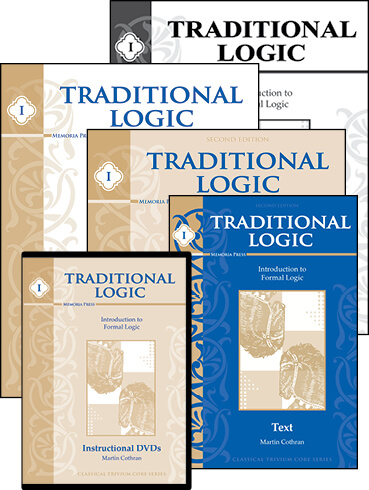
    Learn Formal Logic with the Well Lauded Traditional Logic by Memoria Press {A Review}

    For years now, I have read nothing but good things about Logic by Memoria Press, so I was delighted to be offered a chance to review the Traditional Logic I Complete Set this spring with my 12 year old.


    What is Traditional Logic?


    The Traditional Logic I Complete Set is comprised of a text, workbook, teacher key, quizzes and test book, and 2 DVD video course. The DVD's basically say the same thing as the book, we have found, and do so in a rather dry way with a somewhat dated quality.  However, they videos can still be useful for driving points home.

    The text, workbook, and quizzes, we find, are very traditional and "schooly" in presentation, but also quite solid!  In them, students learn about:

    • the Christian theory of knowledge
    • four kinds of logical statements
    • four ways propositions can be opposed
    • three ways propositions an be equivalent
    • seven rules of the validity of syllogisms

    And, don't worry about all those words like "proposition" and "syllogism".  The material presents and defines each clearly!

    Thus, the program is comprehensive, and, if it is used by an at-level student as intended, it is also easy-to-use for clear independent learning.


    How We Used Traditional Logic and What We Thought


    Since my son is not yet at the seventh grade level and Traditional Logic I is geared for students in grades 7-12, I knew the material might be a little beyond his solo capabilities.  So, I talked to my boy about whether he wanted to tackle the course and how best we might approach it.

    Because my oldest son loves to argue and is interested in strengthening his ability to debate with and persuade others, he did want to try
    Traditional Logic I.  (He joked that when he'd finished the course, he would be able to make sound arguments a to why I should allow him endless screen time. LOL!)

    Further, since our family is planning to join a local forensics club in the fall, both my son and I agreed that building a foundation in formal logic might help us succeed, bolstering my ability as one of the club coaches and my son's skills as a debate and speech team member.  (We just love when review opportunities and fall plans dovetail so nicely!)


    Thus, the decision to use the course made, my son and I had one more choice to consider: Would my son use
    Traditional Logic as designed - independently - or would we try a different approach?

    After watching the following video sample lesson and viewing samples of the
    99-page text, 92 page workbook, 114 Teacher Key, and 33 page Quizzes and Tests booklet on the Memoria Press website, we opted for the latter.


    Traditional Logic Sample Lesson

    We knew my oldest son would have a better chance of focusing and engaging with the excellent content of Traditional Logic if we made time to work on the curriculum together, inviting a friend who has an older version of the program to join us. (For having friends join in on learning always makes things more fun, right?)

    Thus, we asked a friend whose family uses the Classical Education model to join us as a study buddy, and, since he is interested in logic and has an older version of
    Traditional Logic (which presents the same thing a the new edition text and workbook do, but all in one worktext), our friend said, "Yes!"


    So began our
    Traditional Logic studies.

    Basically, each week, our friend comes by our home and, the boys and I (re)read and discuss the lesson materials together.  Then, sometimes, I have the boys complete workbook pages together or take provided quizzes, while, at other times, I use the questions in the workbook to do game-show style quizzes with the boys.  Doing so, helps keep the tedium of typical text-and-workbook learning away for my son, while keeping the well lauded material accessible.

    So far, we have completed between 1/4 and 1/5 of the course using this approach and are all learning as we go - even me!

    While we increase our understanding of logic, we share a few laughs, and - okay - some screwed up brow looks, too.  For, as clearly and concisely as formal logic is explained in
    Traditional Logic, the learning curve of logic-specific vocabulary and concepts is still significant.

    Our friend said, "It is hard, but I like it!"

    My son said:


    The book is a little confusing.  There are words like simple apprehension, syllogism, and material, living, sentient, rational substance on the Porphyrian Tree, which just means man.  The words are explained, but it hard to remember all the stuff.

    I want to keep using this though.  It's hard, but I am learning stuff that might help me when I argue with people and when I join CIA (a public speaking and debate team).

    I've been using Logic with my friend and my mom.  It's been going pretty well.  We usually read and talk and, then, do Quiz Time on paper or orally, which makes it fun.

    To be honest, Logic is not the most exciting thing I have ever studied and I would not want to do it on my own, but I want to keep studying it with my friend.  I could not otherwise, because I would not focus well.
    Oh, and there is one unsound argument in the book.  An example says, "All books are boring." That is not true at all. (wink) "

    Obviously, my oldest son and his friend are learning and have more learning yet to do!  So, we have already decided that we will continue to have study buddy logic lessons using Traditional Logic so that the "more learning" will continue to happen.

    We're all pleased with
    Traditional Logic and recommend it to others as a well-written program.


    Learn More


    Ninety Homeschool Review Crew families reviewed either:

    You can find all the reviews by clicking through.

    Read the reviews.


    You can connect on Social Media, too at:


    Crew Disclaimer