Showing posts with label Literacy/Language. Show all posts

Tuesday, 14 August 2018

Enjoy a Paddington Bear Unit Study

We are big picture book lovers in our home, so I was curious to check out one of the Picture Book Explorer Packs from Branch Out WorldPaddington Bear when it came up for review.


Made for Homeschoolers by a Homeschooler


This literature-based unit study is aimed at children ages 5-10, but appropriate for a wider range, too.  It comes as a downlaodable pdf, so you can use it with all your children at once - printing copies of maps, mini-books, and more for each child to complete - or with one child now and another child later.   

Obviously, the study's creator Helen Royston gets that homeschool families appreciate the freedom of being able to ethically print as many copies of the study materials as necessary for family use.  That may be because Helen is a 25+ year homeschool veteran herself.

Like all Picture Book Explorer Packs, the Paddington Bear one has a link to the United Kingdom and provides fun and learning for families.

What Will You Find Yourself Doing During This Unit Study?


Used as designed, you read the picture book Paddington by Michael Bond (ISBN 978-0007236336) over five consecutive days and choose accompanying activities from the study to complete.  These activities are grouped, daily, by subject area:

  • Day 1 – Exploring the Setting:  You can learn about England and Peru, do mapwork, create timelines, make a mini-book about the pushes and pulls of migration, and more.
  • Day 2 – Exploring the Words:  You can read about the author of Paddington Bear Michael Bond, chat about themes, encourage narration, make a vocabulary pocket, spotlight subject-verb agreement, focus on characterization, and adapt stories for different audiences.


  • Day 3 – Exploring the Pictures:  You can learn about the illustrator R.W. Alley, do a picture study of one of the book's illustrations, chat about and/or make a mini-book of architectural features, learn about principles of design and try your hand at overlapping and creating emphasis through the use of color, leading lines, contrast, and position - studying an illustration from the book and, then, creating your own artwork.
  • Day 4 – Exploring Science: You can learn about spectacled bears and fill out a fact sheet if you like, learn about shaving cream, create edible and nob-edible foam, explore steam and do nature study in your garden.

  • Day 5 – Exploring Math, Crafts and More: You can explore parallel and perpendicular lines (in connection with train tracks), play around with numbers spotted in the book, explore spatial awareness with packing (in reality or with a paper template), make shaving foam art, create a cultural craft, cook up recipes, and more.
Truly, if unit studies are your family's favored style of learning, this one is excellently written - providing information and ideas that you might not readily find elsewhere and helping your children make connections while also making memories.

There are over 30 activities described in the book and pages and pages of printables including timelines, mini-books, maps, flags, and notebooking pages.  There are also handy lists of needed supplies and book and film go-alongs. It is a well-written study.

It is also one that can be used flexibly!


How Did We Use This Study So Far?


My children and our lifestyle do not currently accommodate sitting down and reading the same picture book day after day for five days.  Nor are we able to spend time this summer diving into loads of Paddington-inspired activities.

What we have been able to do is cuddle on the couch with a picture book in hand and a unit study nearby on a laptop creen during a few particularly rainy days when other plans have been cancelled. 

As such, we have enjoyed reading together, then, using portions of the unit study pdf on-screen to help guide chatter about the book's author, the illustrator, certain pictures, art and design techniques, and more.

We have also pulled up the included maps and named South America and the United Kingdom, found London and Peru, etc.  (Because we are in a constant battle against paper piles here and simply do not want to print more things that will increase their depth, we chose to do many of the activities in this study through discussion and pointing onscreen rather than through printing, coloring, cutting, and writing.)

We have opted to forgo some of the messier or more time-consuming experiments and recipes included in the study for the time being, but have read through them and are looking forward to trying some out during colder, less busy seasons.

However, because we do like hands-on things, we have not delayed all the fun!


Indeed, we opted for some hands-on art and math -which has been enjoyable (and easier to clean up then science and cooking at this juncture in life!)


We have also borrowed a stack of other Paddington books from our local library to use for free reading and 1:1 reading times and have been happy to revisit the character that we spent time with previously when my oldest was younger.


Without question, as we have revisited Paddigton using our Branch Out WorldPaddington Bear, we have made new connections

We have also been able to apply ideas from the study - such as those we practiced on layering and emphasis - in making cards for a sick friend.


This was a fun endeavor that made the study more valuable to us.


For, in our homeschool endeavors, even more valuable than a lesson learned in connection to a piece of literature, is a concept or skill we can incorporate into daily life.


Inspired by the conversations we had during unit study activities about themes in the book - such a being kind to others...


And, knowing a dear little baby we know is in the hospital with a very serious condition, and we'd be blessed to see his siblings, we decided to step away from just drawing fruits as suggested in the unit study, and, to apply art and design ideas to creating cards with well wishes instead...


I just love that things discussed and focused on with the study transferred to life so easily.

Helen Royston did a wonderful job researching and presenting information, activities, and ideas for this study.  
I truly appreciate how this homeschool resource could provide a full week's worth of homeschool studies or can be used flexibly in the time life allows for it.

Of course, is you are a picture book and unit study lover with elementary-aged children 
Branch Out WorldPaddington Bear  is ideal. 

Learn More

Some of the other Homeschool Review Crew families dove into all of the activities in this unit study 100% and have wonderful photos and thoughts to share.  Be sure to click through to find their reviews.

Monday, 26 February 2018

My Children Found The Starfall Home Membership Fun


"Mom, can we get it?" my younger two children asked when they heard we might be able to review a one year subscription to The Starfall Home Membership from Starfall Education Foundation.  For ever since they had completed all the fun, free options on Starfall.com, they've been curious what learning games and activities might be discovered with a paid membership. 

Since mid-January, my children's curiosity happily satiated.  As a choice during their lesson times, as well as during their free online times, my younger two have been exploring 
The Starfall Home Membership.  


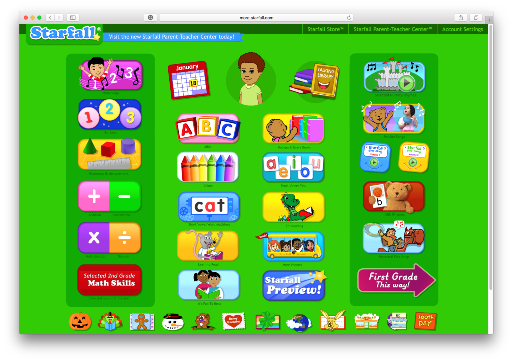
Included in the membership are online and printable activities for:
  • phonics 
  • learning to read 
  • folk tales and fables


  • math 
  • folk songs
  • classical music
  • poetry
  • riddles
  • sign language


    and more!  All of these are super easy for children to navigate, making use of Starfall intuitive, fun, and educational.

    There is also a complete 
    parent-teacher center, which is accessible once a math problem written in words has been solved.  This section of the site  is chick full of helpful information, tips, printables, and more.  There are with worksheet generators.


    The Starfall Home Membership could truly act as a "spine" for learning for pre-k through first grade learners.  It also can engage older children like mine as a supplementary program for fun or to develop lagging skills.  The wide variety of offerings and enjoyable nature of included activities and games makes it especially helpful for reluctant or developing learners, too, I find.  My older child with dyslexia enjoys reading along with portions of the program, reinforcing skills.


    What the Kids Had to Say

    My children are older than the typical pre-k through 1st grade user of The Starfall Home Membership and have no need for the printable portions of it.  Thus, they have been using our membership completely independently several times a week on our laptops or Kindles.  Sometimes, their big brother looked on, too, because the graphics and audio caught his attention.


    My youngest has this to say:
    I wanted to get Starfall, because I had used the free stuff and I wanted to listen to more than one song, read more than a few books, and be able to do all the math stuff, because when you have it free you can only do a few of these.  When we got it, the first thing I did was the folks songs.  They were fun! 

    I like the reading and the math, too.  For the reading, I like the Greek Myths and the stuff about space and firefighters... 


    The math is kind of easy.  It's too easy for me, so I don't use it much except for for fun. 
    I am seven and I think this program is good for ages 2-5, but I still like it.  I would recommend people with little kids to get it.  I will still use it while we have it.  I like it.


    My middle child, who is still developing in some of her literacy skills, said:

    I wanted to get Starfall, because there is a free version and I kept on looking at it.  They had logos on it you could not click through without a membership and I wanted to figure out what they were all about.  I especially wanted to figure out what was in the math section, because there were only one or two things in the free version.  
    When we got our membership, I also realized there were more songs.  They are good.  There are drawings that go along with them, and I like to watch and sing along. 


    I also like the talking library.  It is basically a library shelf in the middle with folk tales and another choice on the two sides of the shelf.  You can click on a book, and it will open.  You can then read along with a voice or read by yourself without the voice.  I did it both ways, because I wanted to see how it is different.  I decided I like it with the voice, because I like how they use expression.  


    I liked all the reading parts of the program, because they are all pretty much like that - you can read along or read by yourself.  That can help kids with reading skills. 


    Of course, I tried the math, too, but it was too easy.  I would like them to make a little harder math. 
    I am ten years old, and I think the math is good for maybe kindergarten through second grade (which Mom later told me is what the program is meant for.)  The reading has different sections for different levels of learners and, I think, is good for anyone still getting stronger in reading.
    The songs are good for anyone.  They are just fun! 


    I am glad we got the program.  I will keep using it to have fun and to have easy breaks between my other lessons.  I would recommend the learning parts for children at least under fifth grade.  For bigger kids, I don't think it's good for main learning - like "this is my curriculum"-  but it's good for a side thing. It could be good for 3-5 year olds for main learning, but I don't think they should be online so much.  The program would work for that, because the lessons are easy and short.  There is math, reading, and other fun parts.

    As you can tell from her narrated review The Starfall Home Membership definitely has appeal and purpose for older children with developing skills.  The audio option and engaging content kept my daughter happy and building her skills.  She did not complain about anything being "babyish", but rather, enjoyed using Starfall, as did her brother.  

    If you have a child who needs some extra practice in developing reading skills and likes short bursts of online learning that can be used independently, I'd recommend a membership to Starfall.  The variety of content, intuitive design, and fun animations and sounds can help your elementary-aged child to gain extra needed practice in order to master skills.  Plus, because the computer website and mobile app are easy to navigate and are free from advertisements and links to pages outside of the Starfall platform, children can use the membership independently while parents enjoy peace of mind.


    Our family will continue to enjoy The Starfall Home Membership in the coming weeks and months.
      
    Learn More


    The Starfall Home Membership is only $35 per year and comes as a single account that can be used by anyone in your immediate family (including grandparents). One email and password for your membership authorizes all your computers and mobile devices, and membership is mobile ready with a download of the Starfall FREE App for Android, Kindle, or iOS.
    .

    Teacher, classroom, and school memberships cost more.


    The Starfall Home Membership {Starfall Education Foundation Reviews}

    Sixty Homeschool Review Crew families tried The Starfall Home Membership out.  Find each family's review by clicking through the banner.

    You can find the Starfall Education Foundation on social media at:
    Is your youngster ready for learning fun?  Take a peak at The Starfall Home Membership!

    Crew Disclaimer

    Thursday, 2 November 2017

    Developing Reading Skills Through Fun Stories with Good Morals {A Magic Stories Review}


    When we were given an opportunity to review The Magic Stories by Allsaid & Dunn, LLC, publishers of The Reading Game and authors of the Wordly Wise series, I was excited, since I knew I could use it with both my struggling reader and my right-age one.

    The Magic Stories {Allsaid & Dunn, LLC. Reviews}


    The Magic Stories is a supplemental reading program designed to help children at a 2nd/3rd grade reading level develop strong reading, comprehension, and writing skills while enjoying tales that contain morals.  As I understand, the program was specifically written as a follow up for children who have used The Reading Game, however, I can say from experience that familiarity with The Reading Game is not a prerequisite for using The Magic Stories. (We've never seen the Reading Game before here.)


    The Magic Stories {Allsaid & Dunn, LLC. Reviews}

    What Is Magic Stories?

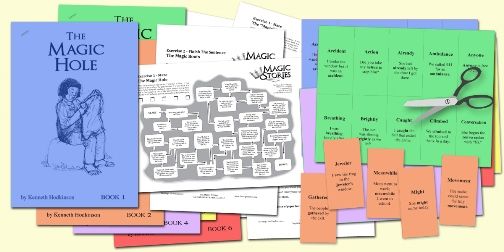
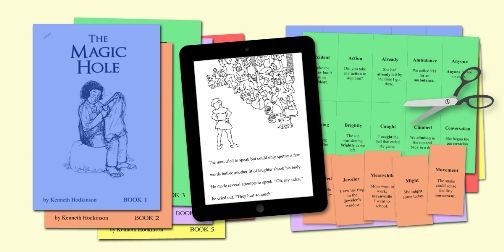
    The Magic Stories, as I mentioned above, is a supplemental reading program that contains stories and exercises.  It comes as a pdf download which is optimized for an IPAD or computer screen so that those who do not wish to use up supplies printing each of the program's six 20-or-so page stories can simply read them on-screen.  I chose, however, to print some of the stories in booklet form since my struggling reader prefers books-in-hand over a screen-in-hand.  Because the pdf pages include plenty of white space and a good-sized font, this worked well for us.


    You may be wondering what is so "magic" about Magic Stories.  Literally, each of the stories contains an element of magic in its plot.

    The Magic Stories {Allsaid & Dunn, LLC. Reviews}


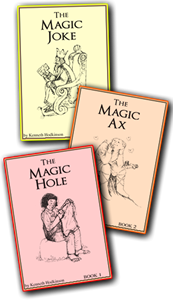
    • The Magic Hole features Ping Ho and his family, who are very poor and are stymied by a magic hole that keeps appearing in their lives and reeking havoc.  They lose rice, money, and even an entire fishing lake due to the hole, but, in the end, are able to take a bad situation and make it better than they could have ever imagined.

    • The Magic Ax tells the tale of a young boy prefers to play in the forest than to help his father chop wood, untl one day, his father breaks his leg, and the boy has no choice but to chop wood for his family.  On his first day doing so, the boy makes meager efforts, dawdling and not even filling the bottom of a cart.  Then, however, he is met with a magic ax that does all his work for him.  Though he feels guilty for taking the credit for the magic ax's work he continues doing so for quite some time.  Then, the ax fails him, and he knows he has to step up to work for his family.  Before long, his work becomes easier as he is no longer burdened by the heavy secret he'd been keeping.

    • The Magic Joke has a princess who ends a war with a Magic Joke.  Her father, though, isn't happy about this since he wanted to win the war and take over the enemy kingdom.  He ends up reading the magic joke, however, and being so overcome with laughter that his daughter is able to take over ruling their country, and, in turn,  uniting the once-warring kingdoms with love instead of violence.


    The Magic Stories {Allsaid & Dunn, LLC. Reviews}

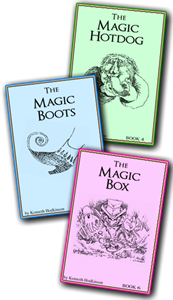
    • The Magic Hot Dog is about a boy named Alfred only wants to eat hot dogs.  In fact, he ends up spending all his money at a fair on 10 hot dogs, and, then, sees a man eating a hot dog that never seems to get any smaller. Of course, Alfred wants that hot dog and, indeed, takes it.  Too bad for him, though - he eats so much he ends up floating away.

    • The Magic Boots is about a young girl named Patty who wants a pair of Pixy Boots that she has seen in her book, but, instead, ends up with Goblin Boots.  Poor her!  Those boots cause so much trouble.  Luckily, though, in he end, things go right.


    • The Magic Box is a Rum-pel-tilt-skin which is written  partly in rhyming verse in partly in paragraph form.  In it, Rum-pel-tilt-skin tricks people into handing over gold to get "magic" straw from a "magic" box.  However, in the end, Rum-pel-tilt-skin's trickery is revealed and he end up meeting his demise in a tantrum.

    More figuratively, Magic Stories aim to make literacy skills "magically" unfold in children by engaging them  in stories and activities that help them practice pre-existing
    phonemic awareness and phonics, while developing fluency, vocabulary, and comprehension skills.Included in the activities accompanying each story are:


    • Naughty 40 Flashcards and Assessment: Each story contains 40 new "naughty words" - words that are not easily decoded using basic phonics.  These words come in easy-to-print flashcards that you simply cut and play with.  They also contain the target words in sentences to aid in vocabulary comprehension/context in reading.  Pre- and post- reading assessments for thee words are also included.


    • A Comprehensions Maze:  These clever True or False quizzes for each story are designed as mazes to keep children engaged.

    • A Finish the Sentence Sheet:  This simple worksheet encourages students to summarize and write in their own words, building comprehension and writing skills.

    • A Finish The Story Prompt:  Imaginative children will enjoy exercising their creativity to write their own stories inspired by the ones they have just read.

    Additionally, there are running record sheets provided free on the Magic Stories website and a brief Parent/Teacher guide for those that like to borrow ideas for structuring lessons.

    The only thing "missing" is an answer key for those who don't want to read the stories and figure out the correct answers for the activities themselves, but, truly, these are not necessary since the stories and exercises are quite simple.  (Simple but effective.)

    Our Experience and Thoughts

    My struggling reader was the one I was most excited to use
    The Magic Stories with, since I thought doing so would help her build skills at a level she could handle.  I also knew my second grader could benefit from the program since he is at the "right" age (and skill level) for it. 


    As things turned out, the "Naughty Words" were a bit too naughty for my struggling reader at first - as were a few of the meant-to-be-decodable words in the stories, and the writing portions of the program did not thrill my second grader.  That doesn't mean, however, that
    The Magic Stories were not fruitful for us.  In fact, I liked that I could pick and choose how to use the program to meet each child where she or he is at.

    For my older child, this meant slowing way down to include plenty of repetition through games with the "Naughty Words" in conjunction with "tag reading" some of the stories.  We still haven't finished all of the stories with her, and, since our primary goal is reading right now, I have not been doing the writing exercise with her.  Since she enjoys storytelling, though, I do plan to cycle around to read some of the stories again with her as a review before having her enjoy the included story writing activities.

    With my second grader, this meant just letting him read and enjoy the stories, while also inviting him to play word card games with his sister and me.  This kept him focused on the fun of the stories and vocabulary, without worrying about writing, which we do in other ways.  He said:

    "I liked it.  The Magic Hole was good.  It was appearing everywhere and was funny!  I like the stories."

    My struggling reader said:

    "I liked how easy the stories were to read and that they were entertaining.  Before we read the stories, we practiced the hard words first with cards.  I could not read some of the cards, so we played games with them until I could.  Then, my brother, my mom, and I tag-read the stories.  There were still some words I didn't know, but I liked the story.  I also like that there was a lot of white space and illustrations.  We decided to save the worksheets."

    I surprised and pleased me that she considered the stories easy to read, because, on all honesty, she has not been breezing through them.  More important, though, than her pace with the stories is her confidence.  Obviously, if she says the stories were "easy", she is gaining confidence.   Awesome!


    The Magic Stories {Allsaid & Dunn, LLC. Reviews}
    If you'd like to learn more about Magic Stories or connect with them, find them at:


    You can also see how 55 Review Crew families liked Magic Stories by clicking through the banner below.


    The Magic Stories {Allsaid & Dunn, LLC. Reviews} 
     
     
    Crew Disclaimer